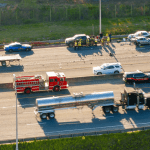
Truck Accident Claims Process | A Step-by-Step Legal Guide

Truck Accident Claims Process | A Step-by-Step Legal Guide
Complete Claims Roadmap: Understanding the Truck Accident Claims Process
The truck accident claims process is not a single event — it is a sequence of legally significant steps that unfolds over weeks, months, or sometimes years following a collision with a commercial vehicle. For victims dealing with injuries, medical appointments, and financial stress, navigating this process without guidance can feel impossible. Understanding each phase of the truck accident claims process — from the moments after the crash through investigation, negotiation, and potential litigation — helps victims make informed decisions at every stage.
Commercial truck accidents involving semi-trucks, 18-wheelers, tractor-trailers, and other big rigs operate under a legal framework shaped by both state law and federal FMCSA regulations. This creates a claims process that is considerably more complex than a standard passenger vehicle claim. Multiple parties may be involved, large commercial insurance policies are typically at stake, and the trucking company’s response team is often mobilized before the victim has even left the hospital. This guide explains what victims can expect and what actions matter most at each stage of the process.
Claim Foundation Basics: How the Truck Accident Claims Process Begins
Securing the Accident Scene
After any collision with a semi-truck or commercial vehicle, safety comes first. Once emergency services have been contacted and medical attention has been sought, the process of documenting the scene begins. Law enforcement will prepare an official accident report — a foundational document in any truck accident claims process. This report captures initial observations about vehicle positions, road conditions, visible injuries, and statements from involved parties.
Victims who are physically able should photograph the scene thoroughly, including damage to all vehicles, road markings, traffic signage, weather conditions, and any visible cargo. These photographs become part of the evidence record that supports the claim throughout the process.
Notifying Insurance Carriers
Most insurance policies require prompt notification following an accident. Victims should notify their own insurer about the collision, but they are not required to provide detailed recorded statements to the trucking company’s insurer without first consulting an attorney. The commercial carrier’s insurance team will begin its own investigation immediately — often with experienced adjusters whose role is to assess and manage the company’s exposure. Understanding this dynamic early in the truck accident claims process helps victims avoid missteps that could affect their claim.
When to Contact a Truck Accident Attorney
Contacting a truck accident attorney as early as possible in the claims process is one of the most consequential decisions a victim can make. An attorney can immediately issue evidence preservation demands to the carrier, identify all potentially liable parties, and begin building the factual record before critical data disappears. Most truck accident attorneys handle these cases on a contingency basis, meaning no upfront legal fees are required to begin.
Investigation Phase Explained: Building the Truck Accident Claims Process Record
Requesting FMCSA and Carrier Records
A significant portion of the investigation in a commercial truck accident case involves obtaining records that only the carrier controls. Under the discovery process in litigation — or through voluntary production requests before a lawsuit is filed — an attorney can seek access to driver qualification files, hours of service logs, vehicle maintenance records, drug and alcohol testing documentation, and cargo manifests. These federally mandated records are central to understanding whether FMCSA violations contributed to the crash.
Analyzing the Commercial Vehicle
The physical condition of the truck involved in the accident is itself a source of important information. Brake wear, tire condition, lighting function, and the integrity of the cargo securement system may all be relevant depending on how the accident occurred. When a mechanical defect is suspected, a qualified engineer or certified vehicle inspector may be retained to examine the truck before repairs are made or the vehicle is returned to service.
Identifying All Potentially Liable Parties
A thorough investigation in the truck accident claims process looks beyond the driver to identify every party whose conduct may have contributed to the crash. Depending on the circumstances, this analysis may include the trucking company, a third-party maintenance provider, a cargo loading contractor, a freight broker, or the manufacturer of a defective vehicle component. Identifying all potentially responsible parties early in the process is important because pursuing claims against multiple defendants follows different procedural rules than a single-defendant case.
Legal Process Defined: Filing and Pursuing a Truck Accident Claim
Demand Letters and Pre-Litigation Negotiation
In many truck accident cases, the claims process includes a pre-litigation negotiation phase. After the victim has reached a stable point in their medical treatment — sometimes referred to as maximum medical improvement — an attorney may prepare a formal demand package. This document outlines the facts of the crash, the applicable legal theories of liability, the nature and extent of the victim’s injuries, and the categories of damages being claimed.
The trucking company’s insurer will review the demand and typically respond with a counteroffer. This negotiation process may resolve the claim without the need for a lawsuit, depending on the parties’ positions and the strength of the available evidence.
Filing a Lawsuit in the Truck Accident Claims Process
When pre-litigation negotiation does not produce an acceptable resolution, the next step in the truck accident claims process is filing a formal lawsuit. The complaint — the legal document that initiates the lawsuit — identifies the parties, describes the facts of the accident, sets out the legal claims being pursued, and requests appropriate relief. The defendant or defendants then have a set period to respond.
It is important to understand that filing a lawsuit does not necessarily mean the case will go to trial. The majority of civil cases, including commercial truck accident claims, are resolved through settlement at some point during the litigation process.
The Discovery Process in Commercial Truck Litigation
Once a lawsuit is filed, both sides engage in formal discovery — the legal process through which parties exchange information and evidence. In a commercial truck accident case, discovery typically involves written questions called interrogatories, requests for production of documents, and depositions of key witnesses including the truck driver, company representatives, and expert witnesses. Discovery in trucking cases can be extensive given the volume of federally mandated records involved.
Damages Framework Overview: What the Truck Accident Claims Process Seeks to Address
Categories of Recoverable Damages
Depending on the specific facts of the case and applicable state law, the damages pursued in a commercial truck accident claim may include:
- Past and future medical treatment costs related to injuries sustained in the crash
- Lost wages and reduced earning capacity resulting from the victim’s injuries
- Costs associated with long-term care, rehabilitation, or assistive devices
- Physical pain and suffering connected to the injuries and recovery process
- Emotional and psychological harm, including anxiety, depression, and post-traumatic stress
- Loss of enjoyment of life when injuries prevent participation in prior activities
- Wrongful death damages when a family member was fatally injured in the truck accident
Punitive Damages in Egregious Cases
In cases where the conduct of the truck driver or carrier was particularly reckless — such as knowingly allowing a driver to operate a vehicle with documented mechanical failures or deliberately falsifying hours of service logs — courts in some jurisdictions may consider punitive damages. These are not available in every state or every case and are subject to specific legal standards that vary by jurisdiction.
How Damages Are Calculated
Calculating damages in the truck accident claims process involves both objective documentation and professional analysis. Medical records and bills, employment and income records, and expert testimony from economists, medical professionals, and life care planners all contribute to quantifying the full scope of a victim’s losses. Non-economic damages such as pain and suffering are not calculated from a fixed formula and depend on the specific circumstances of the injury and its impact on the victim’s life.
Settlement Versus Trial: Key Decision Points in the Truck Accident Claims Process
How Settlements Work in Trucking Cases
A settlement is a negotiated resolution in which the defendant or their insurer agrees to pay an agreed amount in exchange for the victim releasing their legal claims. Settlements can occur at any point in the truck accident claims process — before a lawsuit is filed, during discovery, or even on the eve of trial. Settlement offers a degree of certainty and avoids the time, stress, and unpredictability of trial.
When Cases Proceed to Trial
Some truck accident cases proceed to trial when the parties cannot reach a mutually acceptable resolution. At trial, both sides present evidence and arguments to a judge or jury, who then determine liability and the appropriate damages. Trials in commercial truck accident cases can be complex and lengthy given the volume of evidence, the number of parties, and the technical nature of FMCSA regulations and vehicle systems.
Factors That Influence the Decision
Factors that may influence whether a victim chooses to settle or proceed to trial include the strength of the liability evidence, the extent of documented damages, the defendant’s insurance coverage, the applicable statute of limitations, and the victim’s personal circumstances and preferences. An experienced truck accident attorney can help evaluate these factors without pressuring the victim toward any particular outcome.
Moving Forward Clearly: What the Truck Accident Claims Process Means for Victims
The truck accident claims process is a structured legal journey that begins at the crash scene and may extend through investigation, negotiation, litigation, and resolution. For victims of semi-truck, tractor-trailer, and big rig collisions, understanding this process provides a framework for making informed decisions at every stage. Each phase of the claims process serves a specific legal purpose — and each requires timely, deliberate action to protect the victim’s rights under both state law and federal FMCSA regulations.
No two commercial truck accident cases follow an identical path. The parties involved, the nature of the injuries, the available evidence, and the applicable legal standards all vary based on the specific circumstances of each collision. What remains consistent is the importance of acting promptly, documenting thoroughly, and seeking qualified legal guidance as early in the process as possible.
Start Your Claim: Begin the Truck Accident Claims Process Today
When a crash involves a large commercial vehicle, the opposing side often begins building its case immediately. Knowing how trucking accident claims work — and who may share responsibility — can make a meaningful difference in how you move forward. An attorney familiar with trucking liability law can help identify which parties may be involved.
Speaking with a qualified legal representative sooner rather than later may help ensure key documentation is not lost. Reaching out to experienced legal professionals carries no cost and no obligation — just clarity on where you stand.
Frequently Asked Questions
1. How long does the truck accident claims process typically take?
The duration of the truck accident claims process varies considerably depending on the complexity of the case, the number of parties involved, the severity of injuries, and whether the matter resolves through settlement or proceeds to trial. Some claims are resolved within several months while others involving serious injuries or disputed liability may take considerably longer.
2. Does the truck accident claims process differ by state?
Yes. While federal FMCSA regulations apply uniformly to commercial carriers across all states, the procedural rules governing civil claims, the applicable statute of limitations, and the standards for calculating and awarding damages vary by state. The state where the accident occurred generally determines which procedural and substantive laws apply to the claim.
3. What happens if the trucking company disputes liability during the claims process?
When a carrier or its insurer disputes liability, the truck accident claims process typically advances toward formal litigation and discovery. During this phase, both sides exchange evidence, depose witnesses, and retain experts. A disputed liability case may ultimately be resolved through negotiation informed by the discovered evidence or, if no resolution is reached, through a trial.
4. Can the truck accident claims process address injuries that develop after the crash?
Yes. Some injuries — including soft tissue damage, traumatic brain injury symptoms, and psychological conditions — may not be fully apparent immediately after a commercial truck collision. This is one reason attorneys generally advise victims to reach maximum medical improvement before finalizing any settlement, so that the full extent of current and future medical needs can be factored into the claim.
5. What role does the FMCSA play in the truck accident claims process?
The FMCSA does not participate directly in civil injury claims, but its regulations form a critical backdrop to the legal analysis in every commercial truck accident case. Violations of FMCSA rules governing hours of service, vehicle maintenance, driver qualification, and cargo securement can be used as evidence of negligence in the claims process. An attorney with experience in commercial trucking cases will understand how to identify and use applicable FMCSA standards effectively.
Key Takeaways
- The truck accident claims process begins at the crash scene and involves multiple legally significant phases including investigation, pre-litigation negotiation, potential lawsuit filing, discovery, and resolution through settlement or trial.
- Federal FMCSA regulations create a mandatory documentary record — including driver files, maintenance logs, and hours of service data — that plays a central role in building the factual foundation of a commercial truck accident claim.
- Identifying all potentially liable parties early in the truck accident claims process is essential because semi-truck accidents often involve the driver, carrier, maintenance providers, cargo companies, and vehicle manufacturers, each of whom may bear some responsibility.
- The decision to settle or proceed to trial in a commercial truck accident case depends on the strength of available evidence, the extent of documented damages, applicable state law, and the victim’s individual circumstances — not a one-size-fits-all formula.
- Acting promptly after a big rig or tractor-trailer collision — by preserving evidence, seeking medical care, and consulting a truck accident attorney — can significantly affect what options remain available throughout the claims process.