
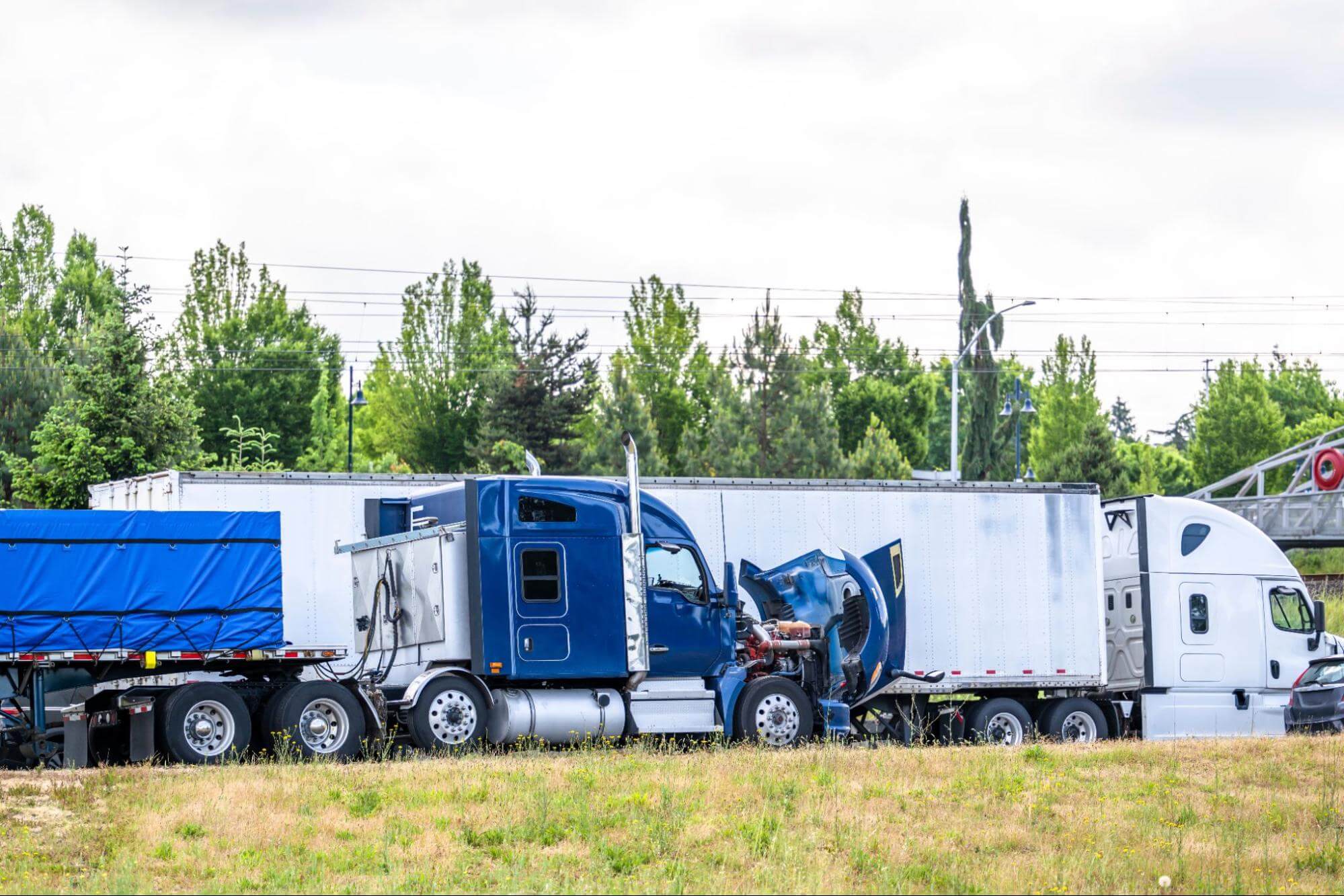
Why Do Semi Trucks Crash: Factors Victims Should Understand
Road Conditions and Environmental Triggers in Trucking Collisions: Why Do Semi Trucks Crash
Why do semi trucks crash on highways and interstates so frequently? The answer often lies in how road and weather conditions affect a vehicle of this size. A commercial truck’s mass makes it far less responsive to sudden environmental changes than a passenger car. Rain, ice, high winds, and reduced visibility all create serious risks for large vehicle operators.
According to the Federal Highway Administration, weather is a contributing factor in a significant share of highway crashes each year. For semi trucks, the risks compound quickly. A truck traveling at highway speed in wet conditions requires far more stopping distance than most drivers assume. When a driver fails to adjust speed and following distance to match the road, the risk of a rear-end or jackknife crash rises sharply.
Road design also plays a role. Sharp curves, unmarked construction zones, and inadequate signage can catch commercial drivers off guard. When a trucking company fails to train drivers on hazard recognition, liability may extend beyond the driver. A legal professional may be able to help you evaluate which parties had a duty of care in your situation.
Cargo-Related Failures That Trigger Semi Truck Wrecks
Improper cargo handling is a direct cause of many commercial vehicle crashes. When freight is not secured according to federal standards, it can shift during transit. That shift changes a truck’s center of gravity. The result can be a rollover, a lane departure, or loss of vehicle control on a curve or hill.
The Federal Motor Carrier Safety Administration sets specific cargo securement rules for commercial carriers. These rules define how different load types must be tied down, blocked, or braced. Violations of these rules are a form of negligence. Responsibility may fall on the driver, the loading crew, the shipper, or the trucking company — depending on who handled the freight.
Overloaded trucks also pose a serious risk. Excess weight strains brakes, tires, and suspension systems. It also affects how the truck handles turns and emergency maneuvers. If a crash occurred after a truck exceeded its legal weight limit, that detail may be legally significant. An attorney familiar with trucking liability and negligence may be able to explain how cargo violations apply to your case.
How Driver Scheduling and Carrier Practices Contribute to Crashes
Commercial trucking operates under intense delivery pressure. Drivers are sometimes pushed to meet tight schedules that leave little room for adequate rest. While federal hours-of-service rules exist to prevent this, enforcement gaps persist. When a driver operates beyond legal driving limits, fatigue impairs reaction time and decision-making.
The National Transportation Safety Board has identified fatigued driving as a recurring factor in fatal truck crashes. Beyond fatigue, some carriers fail to screen drivers adequately during the hiring process. A driver with prior violations or a disqualifying medical condition may still be placed behind the wheel. When that happens, the carrier may bear responsibility for negligent hiring or retention.
Fleet maintenance schedules also matter. Brake failures, blown tires, and steering defects do not occur randomly. They often follow from deferred maintenance and skipped inspections. Federal law requires regular inspection, repair, and maintenance of commercial vehicles. When a carrier ignores that obligation, victims may have grounds to pursue a claim against the company — not just the individual driver.
Crash Causes Shape Legal Responsibility
Understanding why do semi trucks crash is more than an academic exercise. The specific cause of a crash often determines who may be held legally responsible. Road conditions, cargo handling, scheduling practices, and fleet maintenance all interact in complex ways. Each factor points to a different party — the driver, the carrier, a shipper, or a maintenance contractor. A licensed attorney can review the facts of your case and help identify where legal responsibility may lie. Taking time to understand the cause may make a meaningful difference in how your claim is evaluated.
Speak With a Legal Professional About Your Trucking Accident
If you or someone you know was injured in a commercial truck crash, legal guidance may help clarify your options. The causes of these accidents are rarely simple, and the parties involved often have legal teams working quickly to protect their interests. Speaking with a qualified attorney soon after the crash may help preserve important evidence. You can connect with a trucking accident lawyer for a case review. You can also learn more about your rights by visiting traffic accident resources. Attorneys who handle these cases understand the federal regulations involved and can explain how they apply to your situation. For law firms seeking to connect with injured clients, exclusive legal leads may also be available through Legal Brand Marketing.
Frequently Asked Questions
1. Why do semi trucks crash more often than regular vehicles?
Semi trucks face unique risks due to their size, weight, and the operational pressures placed on drivers and carriers. These factors can increase crash likelihood when not properly managed.
2. Can a trucking company be held responsible for a crash?
Yes, liability may extend to the carrier depending on the circumstances. Negligent hiring, poor maintenance, and improper cargo loading are examples of company-level failures that may support a claim.
3. What role do federal regulations play in trucking accident cases?
Federal rules set by the FMCSA govern driver hours, vehicle maintenance, and cargo securement. Violations of these rules may be used as evidence of negligence in a legal claim.
4. How soon should I contact an attorney after a truck crash?
Acting reasonably quickly may help preserve key evidence, including electronic logging data and inspection records. An attorney can advise on the specific timeline that applies to your situation.
5. What types of parties may share liability in a semi truck crash?
Depending on the cause, liability may involve the driver, the trucking company, a cargo shipper, a maintenance contractor, or even a vehicle manufacturer.
Key Takeaways
- Why do semi trucks crash is a question with legal relevance — the cause often determines who bears responsibility.
- Road conditions, cargo failures, and scheduling pressures are common but distinct crash contributors.
- Federal regulations govern trucking operations, and violations may support a negligence claim.
- Multiple parties, including carriers and shippers, may share legal responsibility for a crash.
- Speaking with a licensed attorney may help you understand your rights and legal options after a trucking accident.


Recent Posts
Why Do Semi Trucks Crash: Factors Victims Should Understand
What Victims Need to Know: Poor Vehicle Maintenance
Poor vehicle maintenance is one of the most preventable — and most legally significant — causes of commercial truck accidents. When a trucking company or driver skips required inspections or ignores mechanical defects, innocent people pay the price. Understanding how negligent upkeep creates liability is the first step toward protecting your rights after a crash.
The FMCSA mandates that commercial motor carriers conduct pre-trip and post-trip vehicle inspections under 49 CFR Part 396. When those inspections are skipped or falsified, carriers can be held legally accountable for any resulting accident.
Step-by-Step Claims: How Neglected Truck Upkeep Proves Negligence
Proving that deficient truck maintenance caused your accident follows a structured legal process. Here’s how an experienced trucking accident lawyer typically builds this type of claim:
- Secure maintenance records — Federal law requires carriers to retain inspection, repair, and maintenance records for at least 12 months (49 CFR §396.3).
- Obtain the post-accident inspection report — Law enforcement often documents mechanical defects at the scene.
- Hire a mechanical expert — An independent engineer can confirm whether a defect directly caused or contributed to the crash.
- Identify all liable parties — Responsibility may extend beyond the driver to the trucking company, fleet maintenance contractor, or parts manufacturer.
- Calculate full damages — Medical costs, lost income, pain and suffering, and future care needs are all compensable.
According to the FMCSA Large Truck Crash Causation Study, brake-related issues alone are among the most common vehicle-related crash factors in fatal truck collisions. This data can be powerful evidence in a maintenance negligence case. Learn more about how liability and negligence apply to these claims.
Common Maintenance Defects That Cause Truck Crashes
- Worn or failed brake systems
- Underinflated or bald tires
- Broken or missing lights and signals
- Defective steering components
- Improperly secured cargo or failing tie-downs
- Cracked windshields impairing driver visibility
Compensation Advantages: What Poor Maintenance Claims Are Worth
Trucking accident claims involving poor vehicle maintenance often yield higher settlements than standard collision cases. Why? Because maintenance neglect demonstrates a pattern of reckless disregard — not just a momentary error.
According to research published by the Insurance Institute for Highway Safety (IIHS), crashes involving large trucks result in disproportionately severe injuries due to the size and weight disparity between commercial vehicles and passenger cars. When mechanical failure amplifies that danger, courts and insurers take note.
Compensation in maintenance-related truck accident claims may include:
- Economic damages: Hospital bills, rehabilitation, lost wages, future medical expenses
- Non-economic damages: Pain and suffering, emotional distress, loss of enjoyment of life
- Punitive damages: Available in cases where the carrier knowingly ignored safety violations
Proven Legal Solutions: Taking Action After a Maintenance-Related Crash
Time is critical after a poor vehicle maintenance truck accident. Evidence disappears quickly — trucks get repaired, logs get altered, and witnesses become harder to locate. Acting fast preserves your ability to build a strong claim.
An experienced attorney can issue a spoliation letter demanding that all maintenance records, electronic logging device (ELD) data, and inspection reports be preserved immediately. This legal tool prevents trucking companies from destroying evidence before litigation begins.
Victims should also document everything at the scene: photographs of the truck, tire condition, brake components, and any visible mechanical defects. This firsthand documentation, combined with professional legal investigation, creates a compelling foundation for your case.
If you’re unsure whether maintenance negligence played a role in your crash, a free claim review can help identify the key factors. Connect with exclusive legal help to get matched with a qualified trucking accident attorney in your area.
Poor Vehicle Maintenance Claims Start Here
Get your free review today if poor vehicle maintenance contributed to your truck accident. An attorney experienced in commercial vehicle negligence can evaluate your case, identify liable parties, and fight for the full compensation you deserve. Don’t let deadlines or destroyed evidence limit your recovery — visit Trucking Accident free claim review and take the first step toward justice now.
Frequently Asked Questions
1. What qualifies as poor vehicle maintenance in a truck accident claim?
Any failure to inspect, repair, or maintain a commercial truck as required by FMCSA regulations — including brake wear, tire condition, lighting, and steering systems — can qualify as poor vehicle maintenance under federal law.
2. Who is liable when deficient truck maintenance causes an accident?
Liability may fall on the trucking company, a third-party maintenance contractor, a parts manufacturer, or the driver — sometimes all of them simultaneously depending on the facts of your case.
3. How do I prove a truck's maintenance was neglected?
Your attorney can subpoena maintenance logs, inspection records, and repair orders, then work with a mechanical expert to link any documented defects to the cause of your crash.
4. Can I still file a claim if the truck was repaired after the accident?
Yes. Federal recordkeeping requirements mean documentation often still exists even after repairs. A spoliation letter can also compel carriers to produce all pre-repair records.
5. How long do I have to file a truck accident lawsuit?
Statutes of limitations vary by state, but most range from one to three years from the date of injury. Acting quickly protects your right to compensation and preserves critical evidence.
Key Takeaways
- Poor vehicle maintenance is a federally regulated issue — FMCSA violations directly support negligence claims against trucking companies.
- Brake failures, tire defects, and lighting issues are among the most common maintenance-related causes of commercial truck crashes.
- Maintenance neglect claims can unlock punitive damages when carriers demonstrate a pattern of ignoring safety standards.
- Acting quickly after a crash preserves critical evidence like inspection logs, ELD data, and mechanical condition reports.
- Multiple parties — including carriers, maintenance contractors, and parts manufacturers — may share liability in poor vehicle maintenance truck accident cases.